**Published:** February 16, 2025
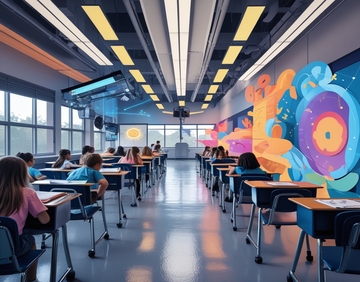
Our education system is over a century old. It was built to produce factory workers. Uniform. Predictable. Compliant.
We don't live in that world anymore. But we still teach like we do.
Students sit in rows. Learn at the same pace. Get tested the same way. And if your brain works differently? Too bad. Adapt or fail.
I know this firsthand. I'm dyslexic. I have ADHD. I went back to university after two decades in the professional world, and you know what I found? Nothing had changed. The same rigid system that failed neurodivergent learners twenty years ago is still failing them today.
It's not just inefficient. It actively suppresses the cognitive styles that drive innovation and creative problem-solving.
The industrial model runs on bad assumptions:
- **Uniform pacing:** Everyone learns at the same speed. They don't. - **Standardized testing:** One type of thinking gets rewarded. Every other type gets penalized. - **Linear progression:** Learning treated as a straight line, when real understanding is messy and interconnected. - **Passive consumption:** Sit down, absorb, regurgitate. That's not learning. - **One delivery method:** Here's the material. Figure it out.
These limitations hurt everyone. But for neurodivergent learners, they're walls.
A dyslexic student might struggle with text-heavy content but have extraordinary visual-spatial reasoning. An ADHD learner might seem disengaged in a lecture but show remarkable focus and creativity when they're actually interested in the topic.
The worst part? When the system consistently fails to recognize how your brain works, you start believing something is wrong with you. That's the real damage. Not grades. Self-worth.
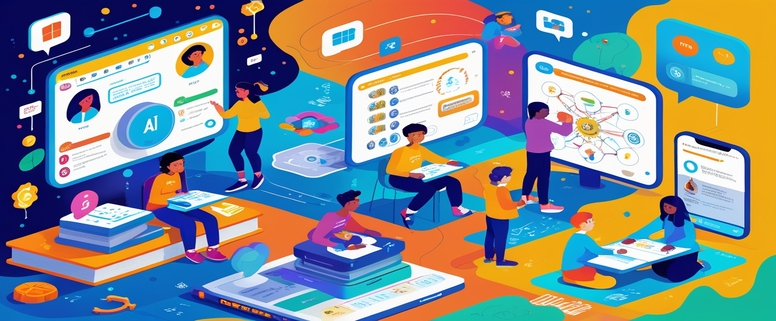
This is where AI gets interesting. Not as a replacement for teachers. As an equalizer.
A well-designed AI system can:
- **Adapt in real time** to how a student is actually performing, not how the curriculum assumes they should perform - **Recognize different cognitive patterns** without judgment or preconceptions - **Present the same concept multiple ways** -- visual, auditory, interactive -- matching how each student actually learns - **Never get tired, frustrated, or run out of time** - **Track subtle learning patterns** to continuously improve the experience
The data backs this up. AI-enhanced learning environments show up to 35% increases in student engagement across diverse populations. For neurodivergent learners specifically, personalized AI tools have shown 20-25% improvements in academic outcomes. For more details, see my complete Transforming Education Through Artificial Intelligence proposal.
Central to my vision is the "Learning is Fun" platform. It's not another ed-tech product that digitizes textbooks and calls it innovation.
It fundamentally rethinks the learning experience:
- **Cognitive style mapping:** The system learns how each student's brain works. Strengths, preferences, where they need support. - **Dynamic content adaptation:** Materials automatically transform to match learning styles. Text becomes visual. Static becomes interactive. Complexity adjusts. - **Engagement optimization:** The system monitors engagement and adjusts in real time. No more frustration spirals. No more boredom. - **Strength-based pathways:** Instead of only remediating weaknesses, it uses each student's cognitive strengths as a bridge to challenging content. - **Metacognitive development:** Students learn how they learn. That's a superpower for life.
The platform uses advanced prompt engineering to create personalized experiences, with research showing up to 40% improvement in comprehension for neurodivergent students. These techniques are detailed in the PromptSage Framework paper.
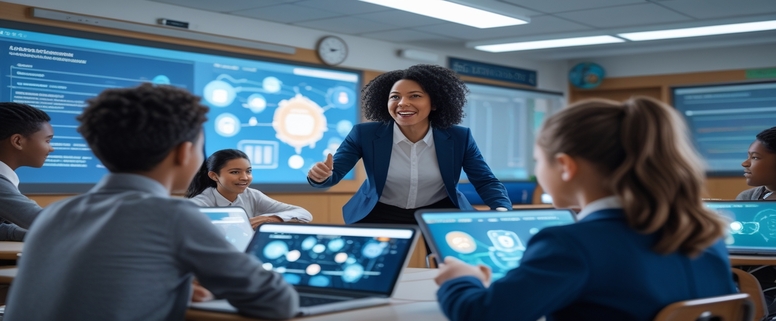
MathSage is our mathematics-focused AI tutor. A prototype is available in the ChatGPT Store. It shows what personalized AI education actually looks like when you build it right.
Here's what it does:
- **Guides, doesn't give answers.** Step-by-step prompts that walk students through reasoning, not shortcuts. - **Builds real understanding.** Chain-of-thought prompting for conceptual depth, not just memorized procedures. - **Scales difficulty intelligently.** Exercises adjust based on progress. Challenge without overwhelm. - **Multiple representations.** Visual, numerical, symbolic, contextual. Same concept, different cognitive pathways. - **Catches patterns in mistakes.** Identifies underlying misunderstandings, not just surface errors.
The key feature is dual-mode functionality. In Tutor mode, rich explanations and guidance. In Examiner mode, assessment without revealing solutions. Academic integrity preserved. Learning support maintained.
Similar assistants are in development for language acquisition, scientific inquiry, and creative expression.
This isn't theory. Initial implementations show clear results:
- **Teachers get time back.** AI handles administrative tasks and learning analytics, reducing workload by up to 40%. Teachers can focus on connection and creativity. - **Previously marginalized students participate.** Schools adopting personalized AI learning report higher engagement from students who were falling through the cracks. - **Struggling students accelerate.** When you match tools to learning styles, students who were "behind" often catch up fast.
We need to stop treating education like an assembly line. Every student's brain is different. That's not a problem to solve. It's a reality to design for.
AI gives us the tools to do this at scale for the first time in history. Not to replace teachers. To give them superpowers. To finally build learning environments that work with human diversity instead of against it.
But we have to be intentional about it. Ethical considerations and human oversight have to guide every step. Technology without wisdom is just a faster way to make the same mistakes.
We harvest what we seed. Let's seed something better.