*Updated: March 16, 2025*
I went back to university after twenty years in the professional world.
You know what I expected? Progress. Evolution. A system that had learned something about how different brains work.
What I found was the same thing I'd left behind. Text-heavy resources. Timed assessments. Linear learning pathways. A system designed for neurotypical minds that hadn't moved an inch.
I'm dyslexic. I have ADHD. These aren't new developments. The system failed me the first time around. It was ready to fail me again.
But this time I had something different. Two decades of professional experience. And AI.
Instead of forcing my brain to fit the system, I started building tools so the system could fit my brain. What started as survival became a vision for how education could actually work.
Let me be direct about what neurodivergent education looks like today.
Dyslexia means text-heavy resources take me significantly more time and energy than my neurotypical peers. ADHD means sustained attention on topics that don't engage me is a constant fight, even when I genuinely care about the subject.
These aren't deficits. They're different processing styles.
Neurodivergent minds often have extraordinary strengths. Pattern recognition. Creative problem-solving. Hyperfocus capabilities. Perspectives that drive innovation.
Traditional education ignores all of this.
The numbers tell the story. Neurodivergent students underperform despite equal or greater intellectual capabilities. In Ireland, neurodivergent students sometimes wait 18+ months for basic support services. And when support finally arrives? It focuses on "fixing" perceived weaknesses rather than amplifying strengths.
Read that again. We spend resources trying to make different brains act normal instead of leveraging what makes them powerful.
My journey started simple. I needed to survive academically. So I built AI tools tailored to how my brain actually works.
**For my dyslexia:** - Tools that transform dense academic papers into structured, keyword-focused summaries with visual organization - Conceptual maps that turn complex ideas into visual representations, playing to my strong visual-spatial processing - Multi-modal converters that take single-format content and present it as text, audio, and visual diagrams simultaneously
**For my ADHD:** - Focused question generators that create targeted questions about study materials, keeping me actively engaged instead of passively reading - Chunked learning modules that break topics into segments sized for how attention actually fluctuates - Hyperfocus channels that connect technical content to my areas of intense interest, creating bridges into material that would otherwise lose me
These tools became my cognitive scaffolding. Material that once required exhausting effort became accessible. Concepts that seemed impenetrable became clear when presented in formats that matched how my brain processes information.
The shift was dramatic. Not because the content changed. Because the delivery finally matched the receiver.
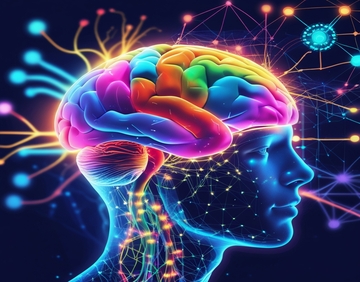
*[AI-powered personalized learning illustration]*
Here's where it gets interesting.
I started building these tools just to keep up. Accommodation. Survival. But as I understood AI capabilities better, I realized something bigger. These tools don't just compensate for differences. They amplify strengths.
That changed everything.
**Pattern recognition.** AI tools can highlight conceptual patterns across subjects, making connections that play directly to how neurodivergent minds naturally think. This isn't simplifying content. It's reorganizing it to match cognitive strengths.
**Hyperfocus as a feature, not a bug.** Instead of fighting attention fluctuations, AI can identify peak engagement windows and present challenging material during those periods. Review and reinforcement happen during lower-focus times.
**Non-linear thinking unleashed.** Traditional education forces linear sequences. AI creates flexible, interconnected learning pathways that match how neurodivergent brains actually build understanding.
This approach doesn't lower the bar. It raises the ceiling. Same standards. Different pathways. Better outcomes.
My personal experience isn't just anecdotal. Research confirms it.
Properly designed AI tools show up to 40% comprehension improvement for neurodivergent students when the system matches their cognitive style. That's not a marginal gain. That's a different trajectory.
Why does it work?
- **Cognitive load optimization.** Presenting information in formats aligned with processing strengths frees mental resources for actual learning. No more burning energy on format translation. - **Engagement amplification.** Personalized content maintains higher engagement. For ADHD learners especially, engagement is everything. Performance swings wildly based on interest level. - **Adaptive pacing.** AI adjusts presentation speed based on real-time comprehension signals. No more falling behind because the pace is wrong. No more zoning out because it's too slow. - **Multimodal reinforcement.** Information through multiple channels creates stronger neural pathways. This is especially powerful for dyslexic learners who struggle with single-format presentation.
The benefits go beyond grades. Reduced anxiety. Better self-efficacy. Improved persistence. When the system works with your brain instead of against it, everything changes.
I want to be clear about something. These tools don't make education easier. They make it accessible.
My dyslexia tools don't eliminate text. They transform how text is processed and integrated with other formats. My ADHD tools don't reduce complexity. They restructure engagement patterns to maintain focus on complex topics.
Same high standards. Alternative pathways to mastery. That distinction matters.

What started as personal survival tools has grown into something bigger. The "Learning is Fun" platform and tools like MathSage are systematic implementations of these principles, designed to serve diverse neurodivergent profiles at scale.
The approach:
- **Cognitive style mapping** identifies individual learning patterns using the PromptSage Framework - **Adaptive content transformation** automatically converts materials into optimal formats for different cognitive styles - **Strength-based pathways** create learning routes that leverage natural cognitive strengths - **Metacognitive development** helps students understand their own learning processes and self-advocate
None of this requires rebuilding educational content from scratch. It restructures how existing knowledge is presented, accessed, and engaged with.
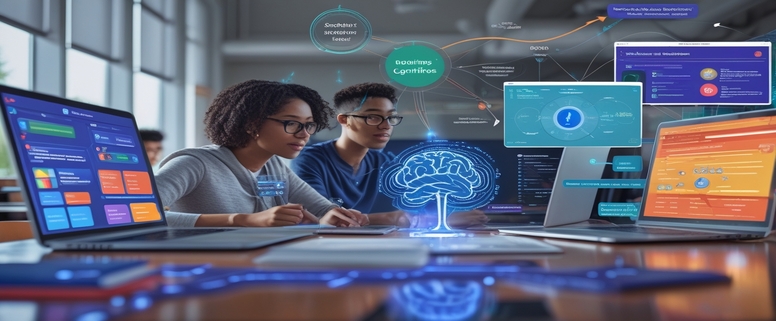
*[AI-powered personalized learning illustration]*
The potential ahead is massive.
Real-time cognitive state detection using subtle engagement signals. Immersive multisensory environments that engage multiple cognitive pathways at once. Collaborative filtering for cognitive styles that predicts effective learning approaches before they're tested. Self-evolving personalization that continuously refines its understanding of how each person learns.
Every advancement closes the gap between standardized education and the actual diversity of human cognition.
My journey from struggling in traditional education to building AI-enhanced learning tools isn't just a technical story. It's a shift in how we think about neurodivergence.
These aren't deficits to overcome. They're different ways of processing information. Often powerful ones.
AI gives us the ability to align education with cognitive diversity for the first time. Systems that adapt to individual minds instead of demanding minds adapt to a standardized system. This perspective aligns with my broader Reflections on Humanity and AI.
The projected 20-25% improvement in performance metrics is significant. But it's not the point.
The point is recognizing that neurodivergent minds bring unique perspectives, problem-solving approaches, and creative insights that we desperately need. And building systems that actually let those minds thrive.
I've been on both sides. Struggling in a system that wasn't built for me. And building tools that finally work with how my brain operates.
Neurodivergence isn't a barrier to excellence. It's a different path to it. We just need to stop forcing everyone down the same road.