!Ethical AI Implementation in Education: Balancing Innovation and Responsibility Cover
*Published: March 16, 2025*
AI is reshaping education. Personalised learning, adaptive tools, instant feedback. The potential is real.
But here's what keeps me up at night.
Education shapes developing minds. It influences opportunities. It determines long-term outcomes for the most vulnerable people in society. When an AI system recommends what a child should learn next, it's not just processing data. It's influencing human potential.
And we're rushing into this without thinking hard enough about the ethics.
Building AI educational tools like the "Learning is Fun" platform and MathSage taught me something I didn't expect. The technical challenges are the easy part. The ethical ones? Those are where the real work lives.
I built a four-pillar framework to guide this: Transparency, Fairness, Privacy, and Accountability. Not as an afterthought. These principles sit at the highest level of the PromptSage framework's XML hierarchy, meaning they override everything else in the system.
Let me break down why each one matters.
Before the solutions, here's what we're actually dealing with:
- **Algorithmic bias** -- AI trained on existing educational data can replicate and amplify the exact disparities we should be fixing. Socioeconomic, cultural, cognitive. All of it. - **Privacy exposure** -- These systems collect data about learning patterns, cognitive abilities, and behavioural tendencies. For minors. Think about that. - **Black box decisions** -- AI makes educational recommendations nobody can explain. Not the teacher. Not the parent. Not the student. - **Eroding autonomy** -- If students treat AI recommendations as gospel instead of guidance, we're killing the critical thinking we're supposed to be teaching. - **Deepening the digital divide** -- Uneven access to AI tools creates new layers of inequality on top of the ones already there. - **Sidelining humans** -- Bad implementation pushes out the mentorship, inspiration, and ethical guidance that no algorithm can replace.
None of this means we should stop. It means we need to be much more intentional about how we build.
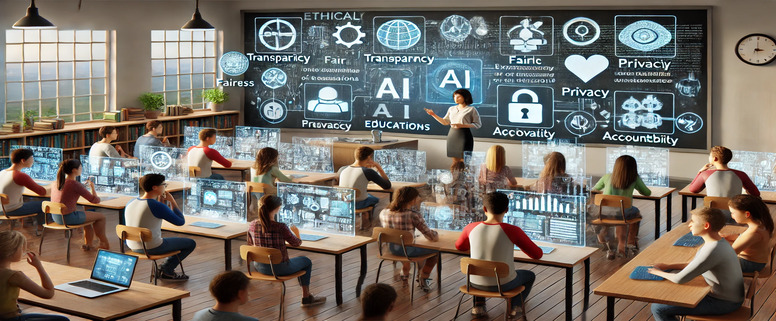
If students and teachers can't understand why an AI made a recommendation, we have a problem. Period.
In MathSage, the system doesn't just flag a mathematical error. It explains the underlying concept that needs reinforcement. Students see the reasoning, not just the result.
On the "Learning is Fun" platform, there's a "How does this work?" feature. Students get age-appropriate explanations of how content is personalised. Teachers get deeper access to the models and decision processes behind the scenes.
We also draw clear lines about what the AI can and can't do. Is it giving a fact? A reasoned analysis? A probabilistic guess? People deserve to know.
The goal is informed trust. Not blind faith. Not paranoid rejection. Understanding.
This one is personal for me.
As someone with ADHD, dyslexia, and autistic traits, I know what it feels like when systems aren't built for how your brain works. AI in education has to do better.
That means training on diverse data. Not just demographically diverse but cognitively diverse. Different learning styles. Different cultural contexts. Different ways of processing information.
We run regular bias audits. Does MathSage explain things equally well to students from different backgrounds? Different cognitive styles? If not, we fix it.
The system adapts to how each individual student actually learns. Not based on demographic assumptions. Not based on group stereotypes. Based on real interactions.
On the "Learning is Fun" platform, we built "fairness circuit breakers" that flag potential bias in recommendations for human review. Multiple cultural contexts. Diverse role models. Accommodations for different cognitive styles baked in from the start.
AI educational tools should be equalisers, not amplifiers of existing gaps.
Educational AI collects sensitive data about children. Full stop. That demands exceptional care.
Our approach:
- **Data minimisation** -- Collect only what's needed for the educational purpose. Nothing extra. Regular reviews to make sure we're sticking to this. - **End-to-end encryption** -- All student data, in transit and at rest. Extra protection for information about learning challenges. - **Age-appropriate consent** -- Tiered models. Guardian involvement for younger students. Developmentally appropriate explanations for everyone. - **On-device processing** where possible. Anonymisation for system improvement. Strict access controls on who sees what. - **GDPR compliance** and educational privacy law adherence, with specific attention to the enhanced protections required for minors.
Educational benefits should never come at the cost of student data security.

This is where it gets exciting. Truly ethical AI in education doesn't just accommodate different learners. It amplifies what makes each one exceptional.
**Pattern recognition** -- AI can surface conceptual connections across subjects that match a student's natural pattern-seeking abilities. Not simplifying content. Reorganising it.
**Attention optimisation** -- Instead of fighting natural attention patterns, identify the peak engagement windows. Present challenging material then. Use other periods for review.
**Multiple expression pathways** -- Let students demonstrate understanding however their brain works best. Visual, auditory, interactive. Maintain the rigour. Change the medium.
This is what the "Learning is Fun" platform does through adaptive algorithms that identify and build on individual strengths rather than only targeting deficits.
> Ethical AI in education isn't about perfect systems. It's about placing human values at the centre of every technical decision.
Clear responsibility chains. Who is accountable for technical performance? For educational outcomes? For addressing concerns? Name names. Assign roles.
Regular impact assessments. How are these tools actually affecting different student populations? What are the unintended consequences nobody predicted?
Feedback channels for everyone -- students, parents, educators, administrators. Not suggestion boxes that go nowhere. Real mechanisms that drive change.
In MathSage, an educator dashboard shows AI decision patterns and lets teachers override recommendations. We have an ethics review board with educators, cognitive scientists, and ethicists who evaluate system impacts.
Most importantly: human-in-the-loop design. AI augments human judgment. It doesn't replace it. Critical decisions about student advancement or assessment always require a human.
Principles without implementation are just words. Here's how we put this into practice:
**Ethics-first development.** We don't bolt ethics onto finished systems. We start there. In the PromptSage framework, ethical guidelines sit at the top of the hierarchy, overriding everything below them.
**Educator empowerment.** The tools enhance teacher judgment, not replace it. Simple mechanisms to override or adjust AI recommendations.
**Inclusive design.** Diverse stakeholders throughout the entire development process. Educators, students, parents, accessibility specialists. All of them, from day one.
**Continuous evaluation.** Regular audits, stakeholder feedback, impact studies. Not a one-time checkbox.
**Adaptive ethics.** As AI capabilities evolve, the ethical framework evolves with them.
I'll say it plainly. Ethical AI in education isn't slowing innovation down. It's the thing that makes innovation trustworthy.
The "Learning is Fun" platform and MathSage prove it's possible. You can build AI that genuinely serves educational values while minimising harm. This aligns with my broader perspective on the relationship between humanity and artificial intelligence.
The future of education isn't humans versus machines. It's thoughtful integration that respects dignity, enhances capability, and reflects our deepest values about what learning should be.
We can build systems that don't just make learning more efficient. We can make it more human.