*This is Part 4. Part 1 covers the foundation. Part 2 covers email, tasks, and dashboards. Part 3 covers circuit breakers, dream mode, and Bristle.*
---
The numbers keep compounding:
**1,087 sessions. 810+ ratings. 24 refined instincts. 126 auto-captured memories. 39 agents. Bristle just hit Level 4.**
But today something different happened. Today I stopped building features inside EMMI-AI's engine and started building the thing that sits above it. A brain. An actual, navigable, compounding knowledge base where EMMI-AI can read and write autonomously, and where I can see everything it knows at a glance.
The inspiration? A post from Andrej Karpathy about using LLMs to build personal knowledge bases. Raw data goes in, the LLM compiles a wiki, and knowledge compounds over time. Simple idea. Massive implications.
I took that concept and bent it into something else entirely.
---
My knowledge was scattered across five systems:
1. **~/.claude/MEMORY/** - 43 deep context files, 24 instincts, 80+ session logs. EMMI-AI's runtime memory. Fast for AI. Unreadable for humans. 2. **Obsidian vault** - 327 notes across 21 folders. My personal notes, client work, college stuff. No navigation. No indexes. No structure. 3. **Todoist** - Task management. Another app. Another subscription. Another thing to check. 4. **Documents folder** - 200+ files across 8 numbered folders. Business plans, research, medical records, CVs. Chaos. 5. **My head** - The most valuable and least searchable source.
Every time I started a session, EMMI-AI had to reload context from 43 memory files. I had to mentally reconstruct what was happening across 9 active projects. Context loading took tokens. Mental loading took energy. And for someone with ADHD, that energy tax is the difference between productive and paralyzed.
---
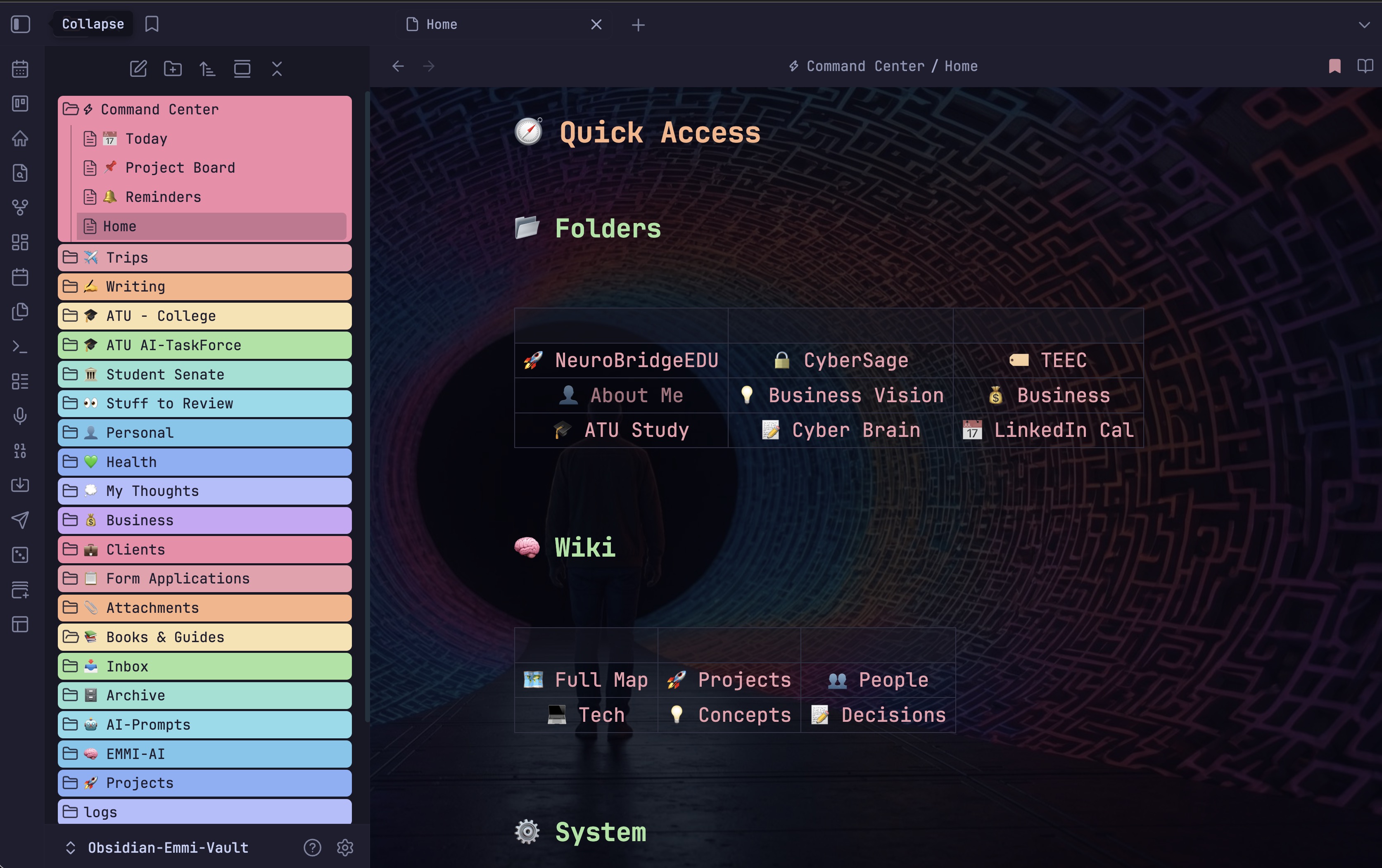
!The Obsidian Command Center - where both brains meet
The concept is simple: **one vault, two brains.**
My existing Obsidian folders stay exactly where they are. Personal notes, college work, client files, writing. Untouched.
EMMI-AI gets its own section: a structured wiki zone that it maintains autonomously. It reads from here at session start (fast context), writes here at session end (knowledge capture), and compiles everything periodically.
The architecture follows Karpathy's pattern but adapted for a multi-project, multi-business operation:
**raw/** - The ingestion layer. Session summaries, research captures, webhook data. Unstructured. EMMI-AI writes here freely.
**wiki/** - The compiled knowledge base. Project pages, concept pages, people, decisions, tech references. Cross-linked. Indexed. This is the Karpathy-style wiki, auto-compiled from raw data.
**indexes/** - Maps of Content. Navigation hubs. The Master MOC links to everything.
**hot-cache** - One file. 500 words. Everything EMMI-AI needs to know at the start of every session. Current projects, priorities, recent decisions. Loads automatically via the LoadContext hook.
The hot-cache is the key innovation. Instead of scanning 43 memory files (expensive), EMMI-AI reads one file (cheap). That file gets updated every time something significant happens. It's like the difference between searching your entire email inbox and reading the sticky note on your monitor.
---
In one session, we created:
**39 wiki pages** - 9 project pages, 10 concept pages, 7 people pages, 5 decision logs, 8 tech reference pages. Every page has frontmatter, backlinks, and navigation. Every page connects to related pages through Obsidian's graph.
**6 Maps of Content** - Master, Projects, People, Tech, Concepts, Decisions. Top-level navigation for the entire knowledge base.
**7 Kanban boards** - One overview board plus per-project boards for NeuroBridgeEDU, TEEC, EMMI-AI, Clients, Personal, and LinkedIn. Each with real tasks imported from Todoist.
**A reminders system** - Desktop notifications via the Reminder plugin. Both EMMI-AI and I can write to the same file. When it's time, the notification pops up.
**A Today view** - Replaces Todoist's daily screen. Overdue tasks, due today, due this week. All from Obsidian's Tasks plugin, no external service needed.
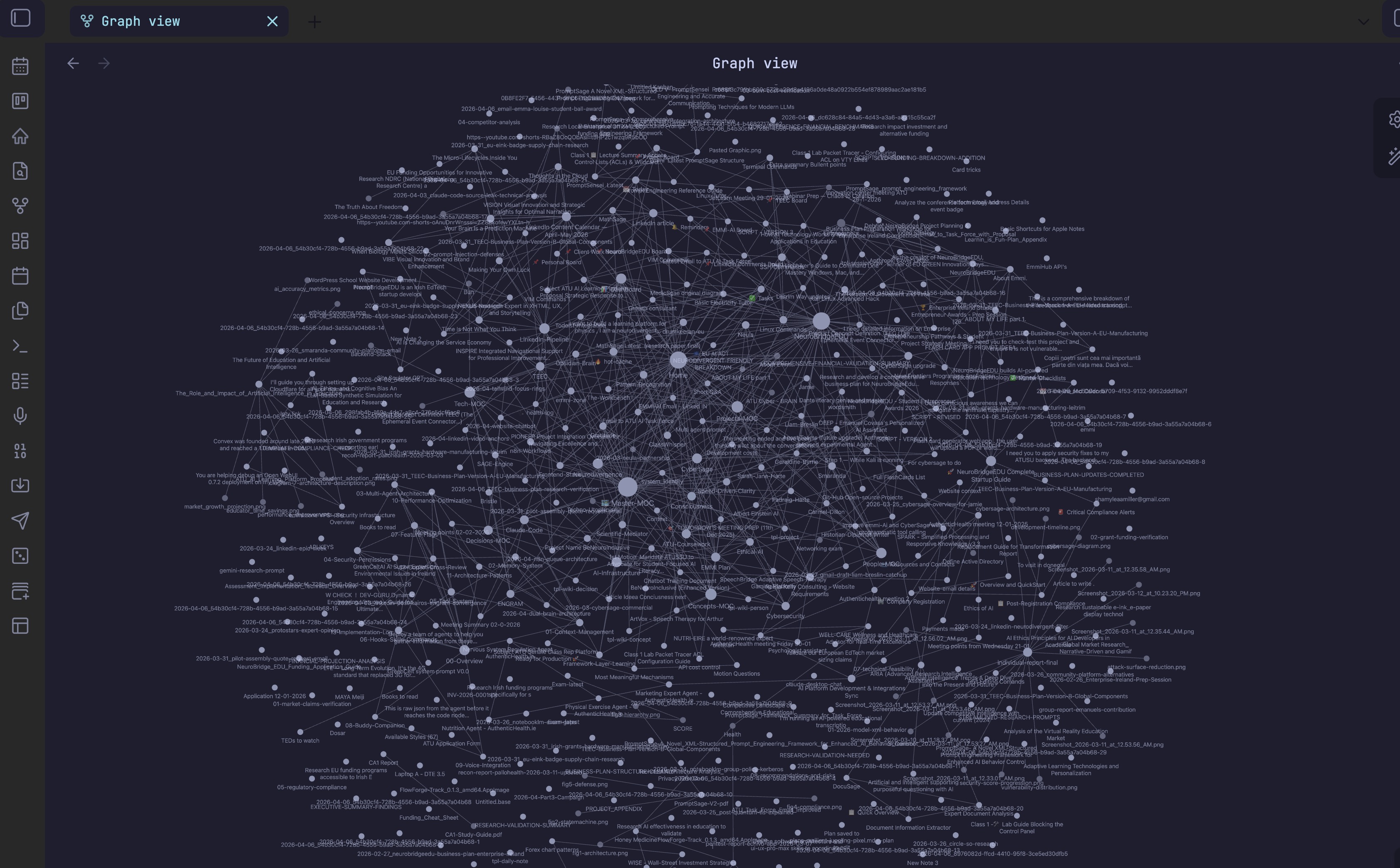
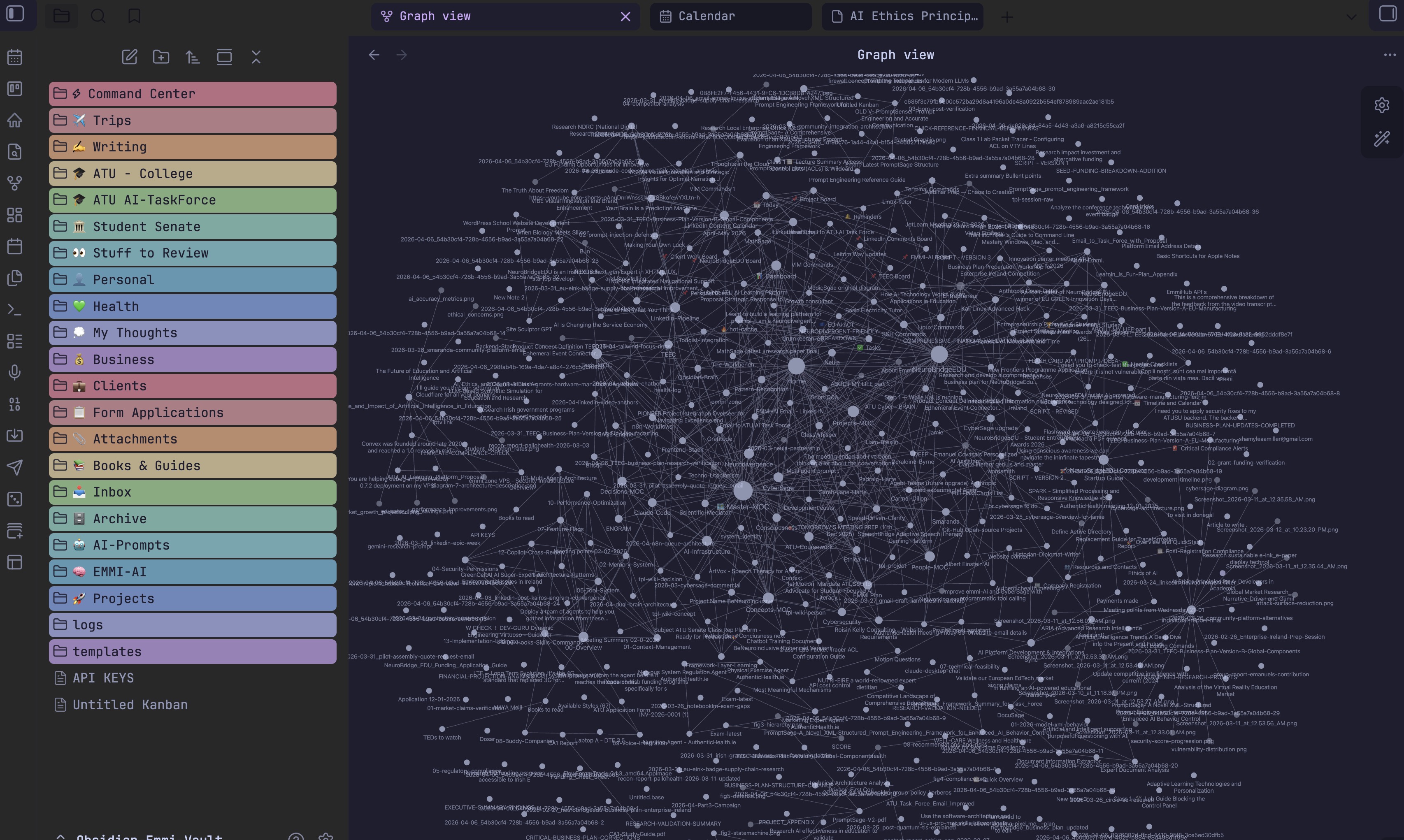
!The full graph view - every note, every connection, one unified knowledge network
---
This wasn't planned. I was looking at the kanban boards we'd just created and thought: why am I paying for Todoist when this does the same thing?
The answer was mobile. Todoist has a great mobile app. Obsidian's mobile kanban experience is mediocre at best.
Then I realized something. When EMMI-AI lives on its own Mac Mini (the plan for Q2), I'll communicate with it via iMessage. I can text "what's due this week?" and get an answer. I can text "move TEEC badge plan to urgent" and it happens.
iMessage becomes my mobile interface to Obsidian. No second app. No sync headaches. No extra subscription.
So Todoist is going away. Everything lives in one place now.
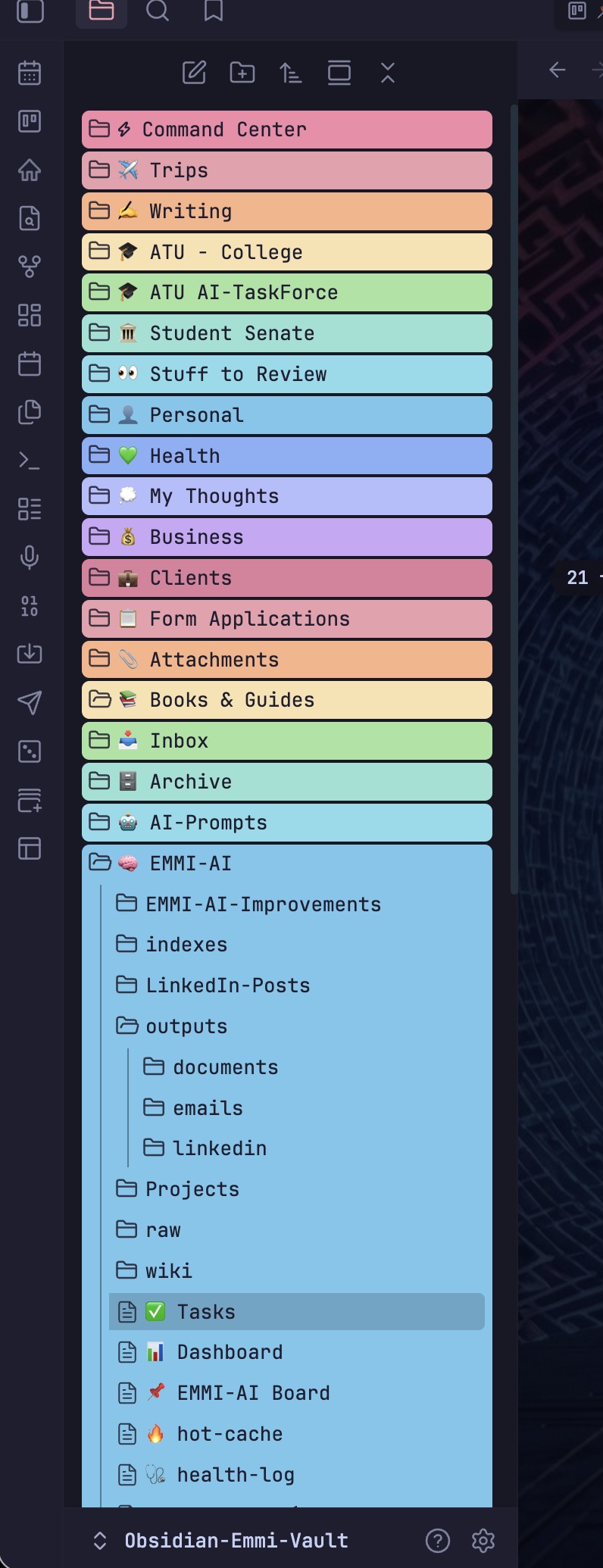
!The sidebar - rainbow folders, organized by domain, everything at a glance
---
With the brain structure in place, the obvious next step was: get everything else in there.
I had 200+ documents scattered across my Mac's Documents folder. Business plans, funding research, medical records, academic papers, CVs, legal correspondence. Eight numbered folders of accumulated life.
EMMI-AI ran the migration in parallel batches:
- **95 Markdown files** moved directly into the vault - **86 PDFs** organized into categorized attachment folders - **27 other files** (images, DOCX, PPTX) distributed to appropriate locations - **34 duplicates detected and skipped** (NeuroBridge and TEEC files already existed in the vault)
After the migration: **547 files in the vault.** Before: 327. Every document from my filesystem now accessible through Obsidian's graph, searchable, linkable.
Then we cleaned the source folders. Renamed them from numbered (`02-PROJECTS`, `04-PERSONAL`) to human-readable (`Projects`, `Personal`, `Brand-Assets`). Flattened unnecessary nesting. Removed empty folders. Deduplicated across directories.
The filesystem went from chaos to a clean 4-folder structure. Everything important is in Obsidian. Everything that stays on disk is organized and findable.
---
Every piece of this system was designed for how my brain actually works.
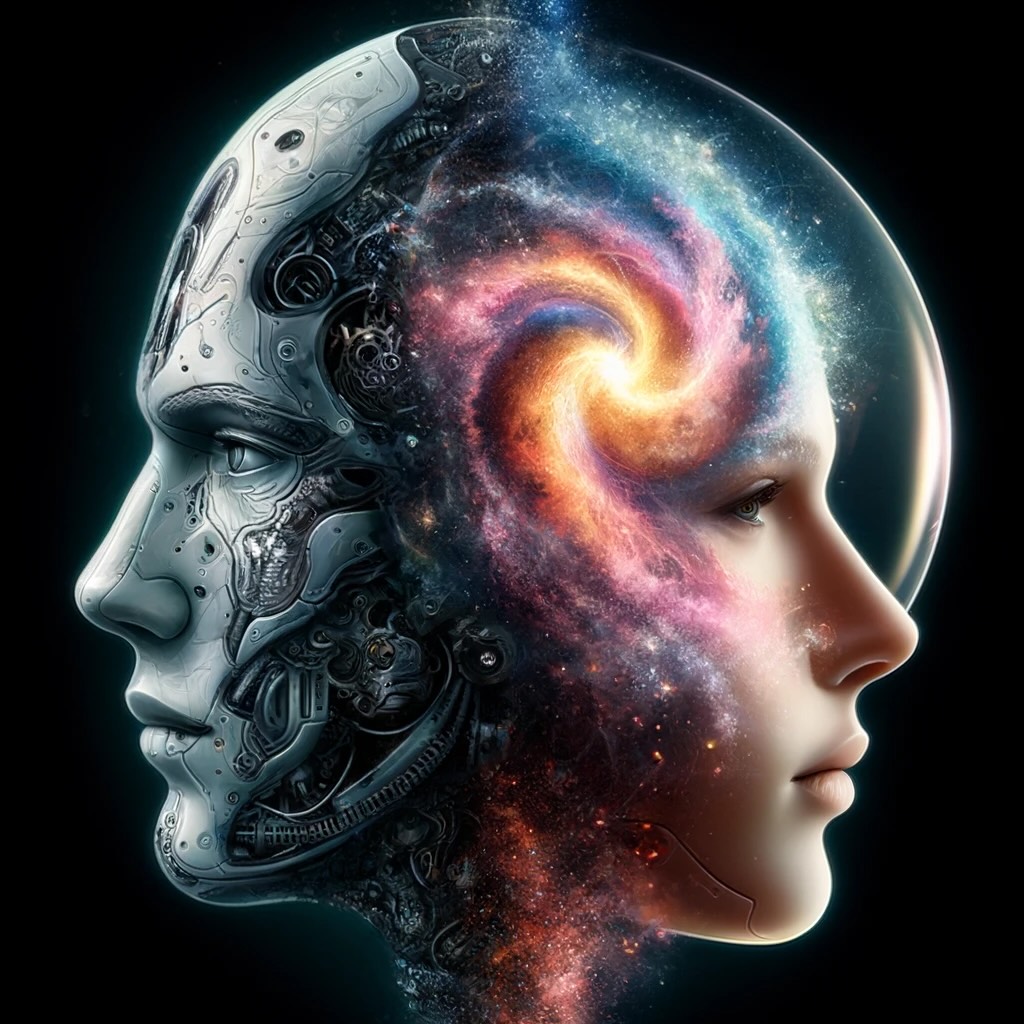
!Neural architecture - where digital and organic thinking merge
I have ADHD and dyslexia. Reading comprehension in the 9th percentile. Perceptual reasoning in the 68th. I process visually, I scan by color, and I lose information that isn't immediately visible.
So:
**Rainbow folders.** Every folder in the Obsidian sidebar has a different color. I don't read the labels when I'm moving fast. I see the color.
**Emoji everywhere.** Status indicators on projects, navigation pills on the home page, visual markers on kanban columns. My eyes grab emojis faster than text.
**One idea per line.** No paragraphs in wiki pages. Bullets, tables, bold keywords. I scan, I don't read.
**The hot-cache.** One file. Current state. No searching. Open Obsidian, it's right there.
**Kanban over lists.** Spatial organization beats linear organization for ADHD brains. Drag a card from "In Progress" to "Done" gives me a dopamine hit that checking a box never will.
This isn't accommodation. It's optimization. Building for neurodivergent patterns doesn't make the system worse for neurotypical users. It makes it better for everyone.
---
!The knowledge graph - connections that didn't exist before today
Open Obsidian's graph view after all this work and you see something that didn't exist 12 hours ago: a network. Concepts connect to projects. Projects connect to people. People connect to decisions. Everything references everything through natural backlinks.
The Master MOC sits at the center. NeuroBridgeEDU is a dense hub connecting to funding research, Enterprise Ireland contacts, academic papers, business plans. CyberSage connects to cybersecurity concepts, tech stack references, client contacts.
This isn't just organization. It's externalized pattern recognition. The relationships I hold in my head, now visible, navigable, persistent. When EMMI-AI compiles the wiki, it finds connections I missed. When I browse the graph, I see relationships I forgot.
For someone whose strongest cognitive ability is pattern recognition, making patterns visible is like giving a musician a bigger instrument.
---
The `ObsidianSync` hook fires at the end of every Claude Code session. It:
1. Reads the current work state from `~/.claude/MEMORY/STATE/` 2. Writes a session summary to `raw/sessions/YYYY-MM-DD_slug.md` 3. Updates the hot-cache timestamp
No manual effort. Every session adds to the brain. Raw data accumulates. The wiki compiler (`/wiki-compile`) processes it into structured wiki pages. Knowledge compounds.
The loop is the same one that powers ENGRAM's instinct learning:
**Observe -> Capture -> Compile -> Apply -> Repeat.**
Different data, same pattern. ENGRAM learns behavioral patterns. The Obsidian brain learns knowledge patterns. Both compound over time. Both make the next session better than the last.
---
The Mac Mini deployment. Obsidian Cloud sync keeps both machines' vaults identical. EMMI-AI runs autonomously on the Mini, writing to its local vault, compiling wiki pages at 2 AM via the KAIROS daemon. I wake up to an updated knowledge base.
iMessage channel for real-time communication. I text from my phone, EMMI-AI responds from the Mini. Task updates, reminders, questions about my projects. The second brain becomes always-on.
The graph grows. Every session, every research query, every decision documented. Not because I'm disciplined about note-taking, because the system does it automatically. That's the whole point.
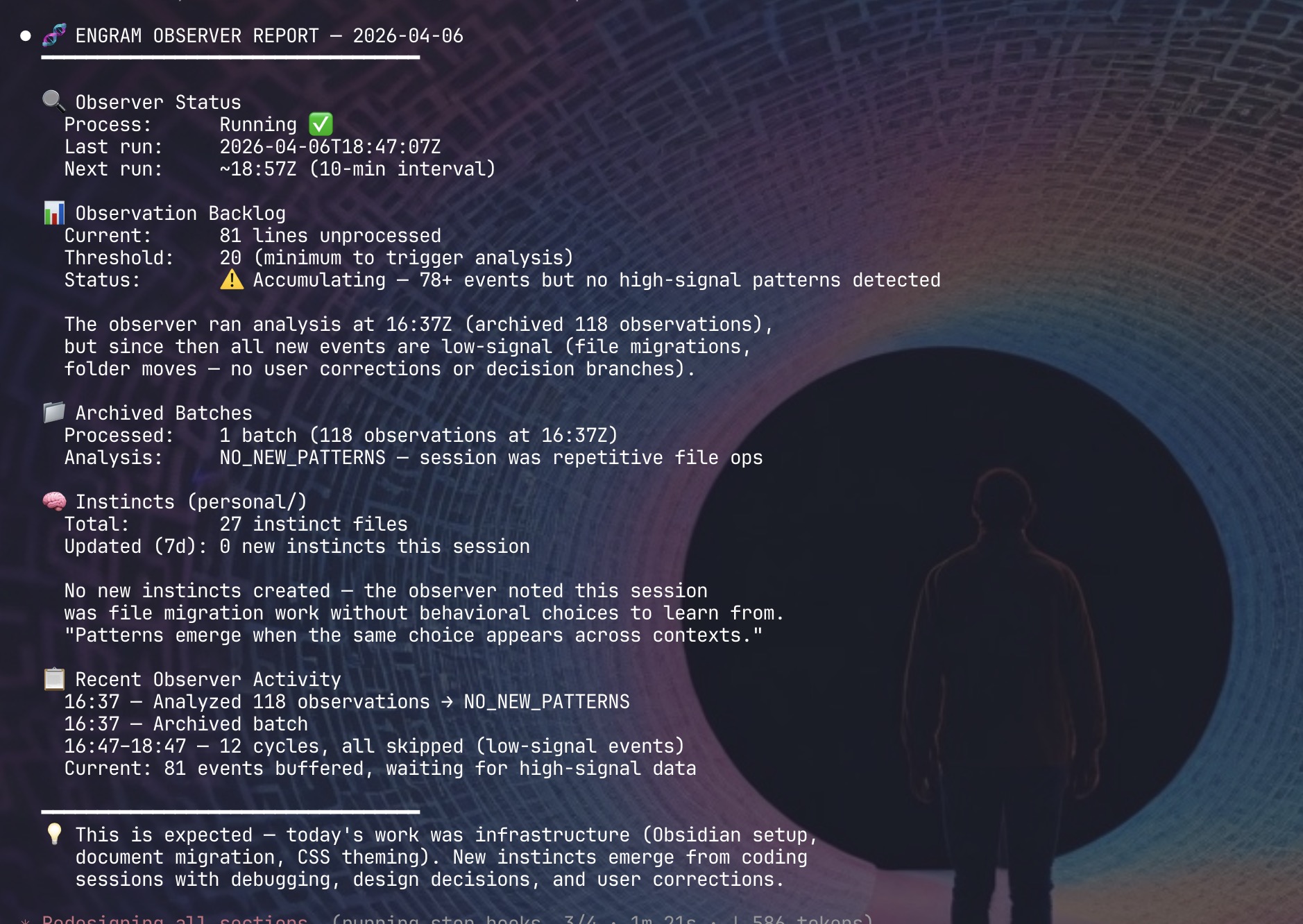
!The observer sees everything - patterns emerging from the noise
---
I didn't build a note-taking system.
I built a shared consciousness between a human and an AI, stored in markdown files, navigable through a graph, compounding with every interaction.
!Where human intuition and machine intelligence converge
The tools are all free or cheap. Obsidian is free. Claude Code is a subscription you might already have. The plugins are open source. The architecture is just folders and markdown files.
The hard part isn't the technology. It's deciding to build for how your brain actually works instead of how productivity influencers say it should work.
My brain works at speed. It processes visually. It loses linear information. It finds patterns nobody asked it to look for.
Now there's a system that works the same way.
And it remembers everything.
---
*This is Part 4 of the EMMI-AI Infrastructure series.* *Part 1: I Built an AI That Learns From Its Own Mistakes* *Part 2: My AI Now Reads My Emails and Manages My Tasks* *Part 3: Building a Self-Evolving AI on My Mac*
*Built by Emanuel Covasa with Claude Code, Obsidian, and an unreasonable amount of determination.*
#AI #PersonalAI #SecondBrain #Obsidian #ClaudeCode #Neurodivergent #ADHD #KnowledgeManagement #Productivity #DeveloperTools