**Published:** December 23, 2025
---
We treat creativity like it's lightning. Random. Mysterious. You either get struck or you don't.
But what if your imagination runs on math?
Not calculus-on-a-whiteboard math. Probability. Combinations. Growth curves. The kind of math that quietly decides which ideas survive and which ones die.
I've been thinking about this a lot. And once you see the patterns, you can't unsee them.
---
Here's the myth: creative genius is about that one brilliant flash of insight.
Here's the reality: it's about volume.
Dean Keith Simonton spent decades studying creative achievement across composers, scientists, and inventors. His finding? **Creative success follows statistical probability.** The more attempts you make, the more likely you hit something great.
Thomas Edison filed over 1,000 patents. Most were forgettable. But somewhere in that pile were the light bulb and the phonograph.
Picasso made more than 20,000 artworks. A handful are iconic. The rest? Nobody remembers.
**Quantity breeds quality.** Every attempt is another roll of the dice.
> "If you want more hits, make more swings." > -- Dean Keith Simonton
---
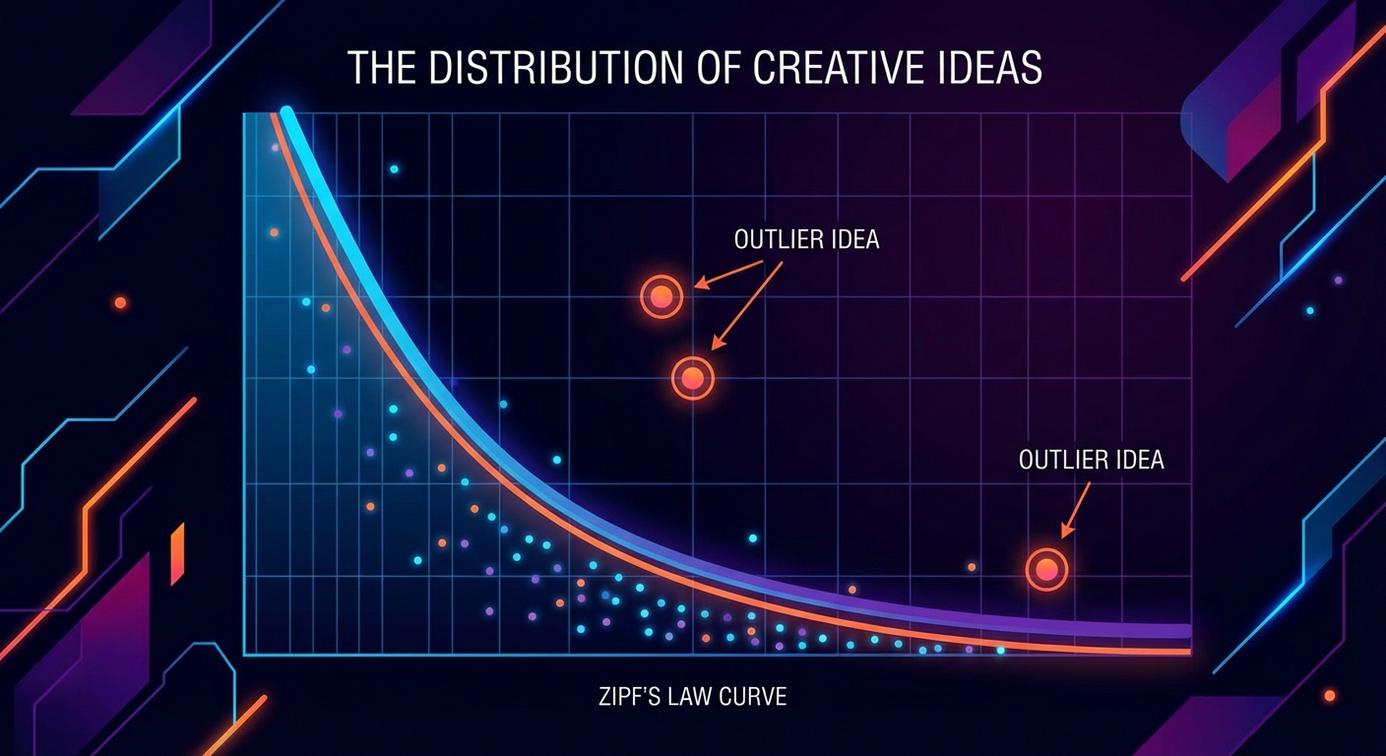
Zipf's Law comes from linguistics, but it applies everywhere. In any large set of outputs, a few are extraordinary, most are average, and a tiny fraction are brilliant.
Apply that to creative work:
- Most ideas you have will be meh - Some will be decent - A rare few will be genuinely great
This shows up in hit songs, bestselling books, viral content. **Most creative output is noise. The magic is in the outliers.**
Sounds discouraging? It's actually freeing. You don't need every idea to be perfect. You need enough ideas that the great ones have room to appear.
> "Brilliance is a statistical fluke -- made more likely by volume."
---
What makes an idea "new"?
Margaret Boden, a cognitive science pioneer, argues creativity is mostly **combinatorial**. You're not creating from nothing. You're remixing what already exists.
Mathematically? Permutations and combinations. A handful of building blocks can generate an astronomical number of arrangements.
- Hip hop sampling: old records, new beats - Meme culture: familiar images, fresh captions - Scientific breakthroughs: old theories, new contexts
With just 10 building blocks, you get over 3.6 million unique combinations.
So when you feel like everything's been done? It hasn't. Not even close. It's the remix that counts.
> "Creativity is just connecting things." > -- Steve Jobs
---
You've heard Gladwell's "10,000 hour rule." The number itself is debated, but the underlying math is real: **skill grows exponentially with practice.**
Early on, progress is painfully slow. But as you invest more time, growth accelerates. Compound interest, but for your brain.
First sketches are awkward. First songs are rough. But as hours stack up, breakthroughs come faster.
**Mastery looks like magic from the outside. Underneath, it's a growth curve.**
> "Genius is one percent inspiration, ninety-nine percent perspiration." > -- Thomas Edison
---
Here's where it gets interesting.
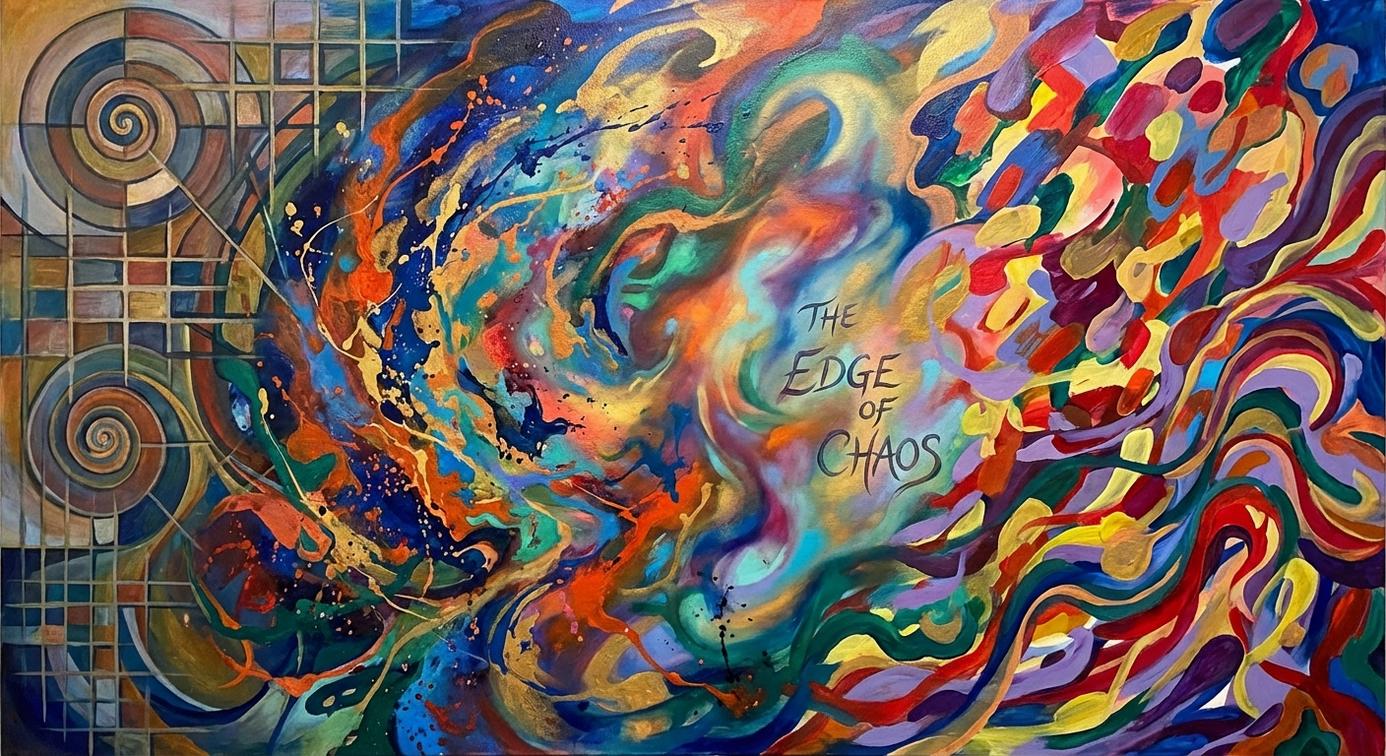
Creativity doesn't live in pure randomness. And it doesn't live in rigid structure. It lives at the boundary between the two.
Too much chaos? Nothing sticks. Too much order? Nothing new emerges.
Mathematicians call this **complexity theory**. The richest patterns in systems like cellular automata appear not in noise, not in repetition, but right at the edge.
That's where creative breakthroughs happen. Structure meets surprise.
> "The edge of chaos is where new worlds are born."
---
- **Produce more.** Each attempt increases your odds. - **Remix relentlessly.** Combine old things into new forms. - **Stick with it.** Time compounds your growth. - **Find the edge.** Balance structure and freedom.
Creativity isn't magic. It's math.
> Creativity = Probability x Combinations x Time x Balance
Next time you doubt your imagination, remember: you're not waiting for lightning. You're running an experiment. Every try moves the needle.
And you don't need a math degree to play the game. Just curiosity, persistence, and the nerve to keep making things.
---